

Student Architects Tackle Rockridge’s Triangle: Affordable Housing Meets Open Space
by Professor Leslie G. Moldow, FAIA
If you are a Rockridge resident, you no doubt are obsessed with visions of what the vacant lot at Claremont and College can become. “A community park,” say some, “affordable housing,” say others.
In the Spring of 2024 and 2025, my second-year architecture studio classes from the Architecture and Community Design program at the University of San Francisco grappled with the oddly shaped site to determine if a happy union could be formed between park advocates and housing advocates. The Architecture and Community Design program at the USF has a strong social and environmental justice focus, so assigning a site that could provide feedback to the Rockridge neighborhood was a good fit.
The Oakland zoning code designates the site in the City’s Housing Element as an S-14 Zone, intended to facilitate housing production on those sites that the City identifies for housing. “Projects on these sites contribute toward meeting Oakland’s needs for lower-income housing and receive By Right Approval.”
The students were guided by an affordable senior housing program and unit design from a reputable East Bay nonprofit housing developer. They assumed the parking necessary for the project would be accommodated in a one-story below-grade parking lot accessed from the southwest end of the site along Claremont Ave. The building, as per zoning allowances, could be five stories tall, and I directed that the ground floor would feature the common areas necessary for housing, along with a clinic and an adult day care center.
Their task, as a design study, was to design a building that balanced the program's need for affordable senior housing units with the community's desire for public outdoor space.
The students, working individually, had only 5 weeks to design a building. Their solutions to the design problem illuminated several different approaches. The designs are purely for test purposes and do not represent anyone’s specific intent to build a building on the site.
Many wrapped the units around a central atrium or open space, and offered the neighborhood a park by pulling the building back from the corner of College and Claremont.
Some configured the building into a U-shape facing the corner that wrapped around an open space.
A few created a “cut-through” open space between the adjacent commercial property to the south and the south wall of the project.
Some out-of-the-box thinkers carved away the east façade to create a park along College Avenue.
The solutions varied in unit count from a low of 47 one-bedroom units to a high of 62 Generally, the fewer the apartments, the greater the open space available for either the neighborhood or building residents.
By engaging in this exercise, the students had the opportunity to tackle a real-world problem, and the community gained insight into what is feasible for our special triangular site in the heart of Rockridge.
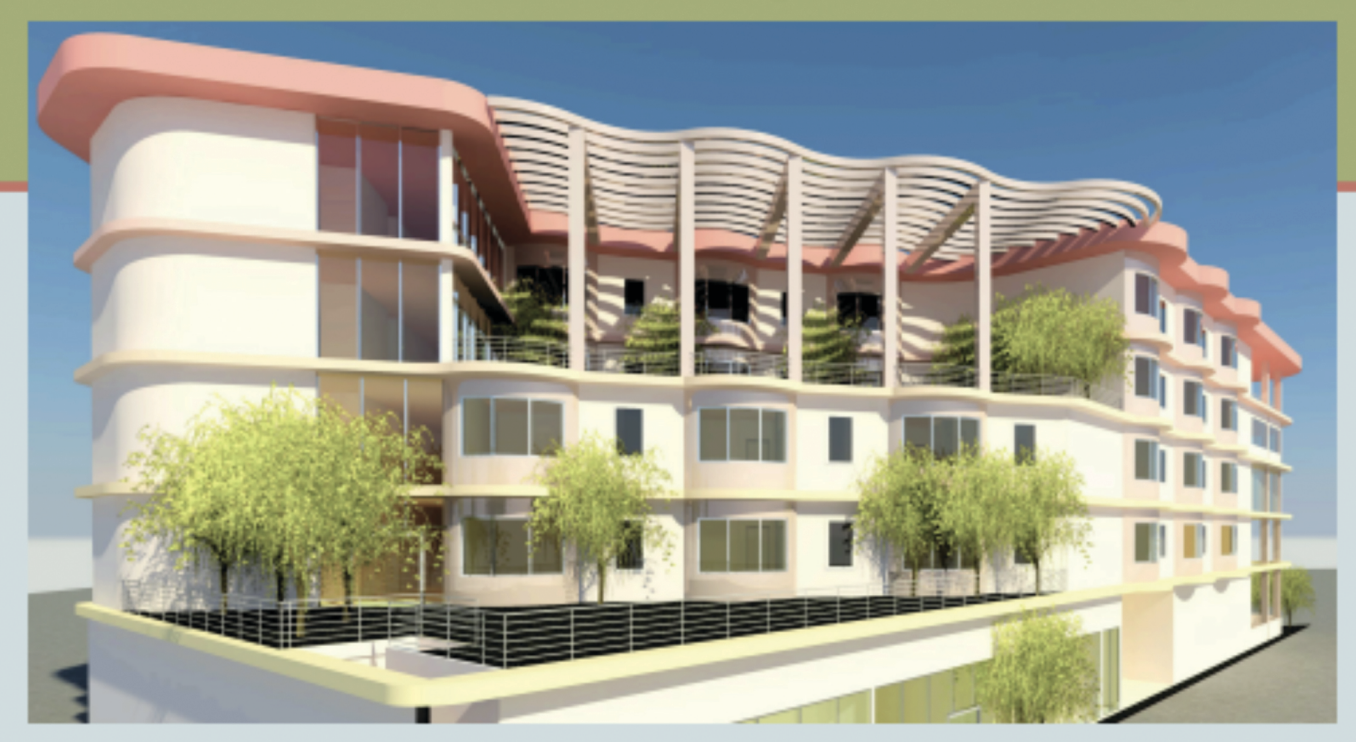
Student Justine Mikaela M. Juco designed low-income housing for seniors with shared gardens.
