Beloved Death Blooming Agave's Notebook Stolen, But Its Story Lives On
by Jana Good and Casey Farmer, RCPC Board Member and Chair
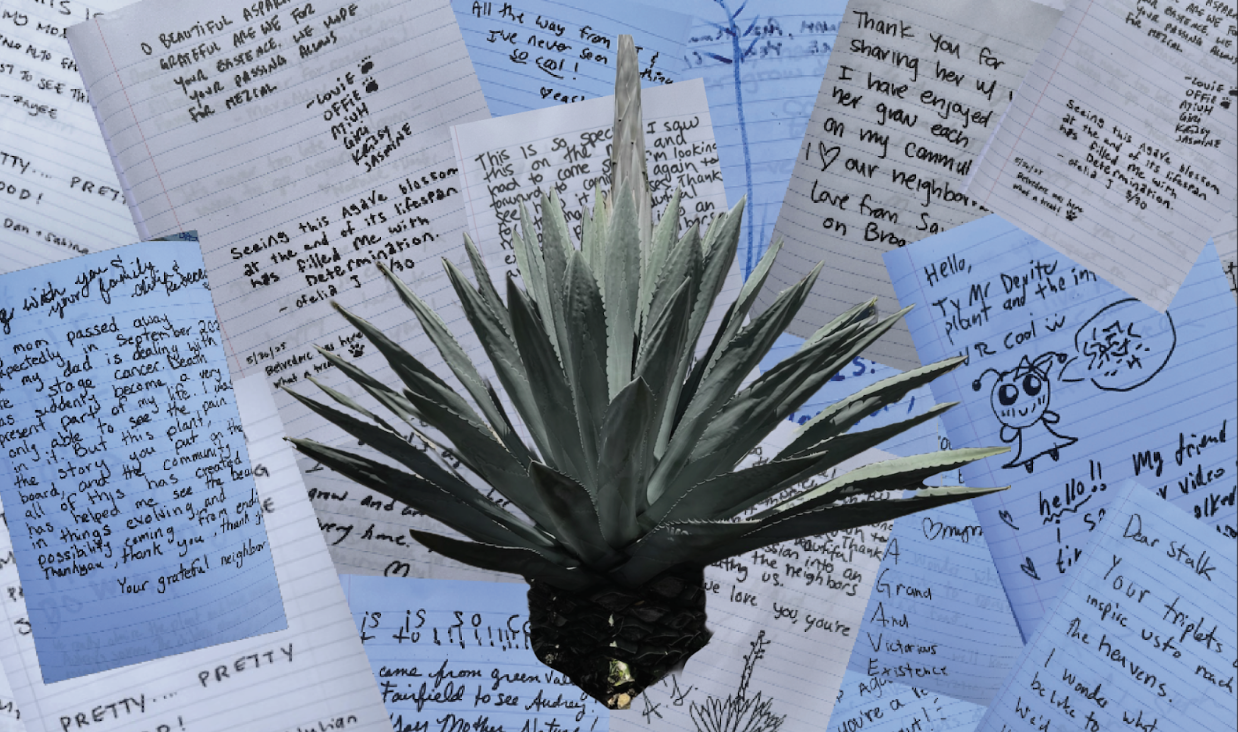
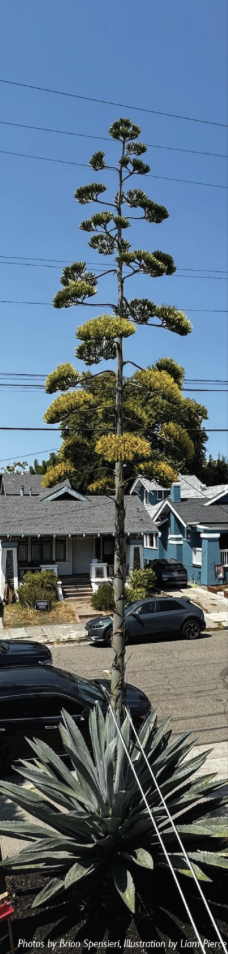
Ironically, a death blooming agave plant has brought plenty of life to Manila Avenue. It has captured the hearts of residents — even tourists from as far away as New Zealand — in a remarkable way. As the plant grew to its current height of 30 feet, so did the notebook that documented its admirers, racking up hundreds of stories and reflections from neighbors and visitors.
But sadly, the notebook, which was kept out front alongside the plant, was stolen on September 25 — the same evening that a rock was thrown through a window next door.
“The notebook is invaluable,” said Brion Spensieri, the owner of the agave. “It means the world to us; I’ve never felt so connected to my community.”
Spensieri and his family documented the story of their century plant agave’s death bloom on a small easel outside their home, just around the corner from the Rockridge Library. When Spensieri and his wife bought their home in 2017, the plant was just 5 feet tall. But in May of this year, as part of the death bloom process, a stalk grew from the center and has since reached over 30 feet tall. The plant is about 33 years old, per aerial photos located by Spensieri’s geologist neighbor.
The plant is an agave americana, from the asparagaceae family, and the bloom definitely resembles its edible cousin, the asparagus. The once-in-a-lifetime flowering event is a “pollinator’s dream,” Spensieri said. He also notes that at peak bloom, the yellow flowers of the seed pods produce a nectar that attracts hummingbirds, bees and butterflies.
Initially, Spensieri put the easel out to explain what the plant was going through for guests at an Easter party they were throwing. After the party, he decided to leave it outside for neighbors to learn too and throughout each step of the plant’s death bloom process, he explained the science of what was happening to it on the easel.
But when people began signing their names and jotting down encouraging words on the white board, Spensieri decided to put out a school composition book for the community to share their reflections. Early entries include drawings of the plant, “love notes” thanking the plant for its beauty, and even poems of reverence.
Over time, visitors began writing more personal reflections in the notebook, sharing their thoughts on the grace and dignity of the agave or, in the face of losing a recent family member, reflections on the catharsis of seeing death as a dynamic process. The first notebook filled up within just two weeks, so a second was taped to it and then a third. In total, there were hundreds of pages of positive and heartwarming comments.
“A city like Oakland can feel very city-y or very neighbhorhood-y,” Spensieri said, noting that the neighbors of his previous home in San Francisco weren’t quite as warm as those in Rockridge. “And this really turned the corner for me; I feel like I’ve got people here now.”
Spensieri said that nowadays, he can’t even go to the mailbox without getting stopped to talk about the plant. His children, ages 6 and 4, love waving from their second story bay window at those who stop to observe the plant.
Neighbor Matty Easton made the plant “internet famous” through his robust posts on Instagram, TikTok and Facebook. Across all platforms, the plant has nearly 10 million views and has generated overwhelmingly positive comments. The online buzz prompted CBS News to do a segment on the plant’s impact on the community on May 29. Tourists visiting San Francisco say they went out of their way to visit the plant.
Spensieri asked fans and followers to recommend names for the agave and hundreds were submitted. Suggestions included Spike, Robert Plant, Tequila, Mamagave and Expira-gus. But Audrey, a nod to the plant in the musical “Little Shop of Horrors,” received the most number of votes.
“Apparently there is a huge crossover between plant people and theater people,” Spensieri said.
Audrey doesn’t need much maintenance or water. Spensieri’s gardener cuts back the lower leaves when they extend beyond the sidewalk, primarily to prevent poking any passerbys. And Spensieri believes the pruning actually stimulated her growth.
Spensieri documented Audrey’s growth using a laser tape measurer and subtracted a few inches to account for its leaning nature. As of October 10, Spensieri believes it has stopped growing as no new bulbs have formed atop the plant.
Fittingly, Spensieri believes Audrey is a female due to her ability to make babies — and a lot of them! The bloom has produced over 1000 seeds, which are all genetically unique. When the seed pods fall from the bloom, Spensieri’s children help collect them, leave them out to dry for a few days and then make them available in a box next to the easel. Many online followers requested the seeds and Spensieri has mailed them — as far away as Honolulu and Connecticut.
He reports that she is growing weaker but that it’s not possible to predict when she will die. Spensieri plans to replace Audrey with one of her clones, called pups, when she completes her death bloom.
Inspired to teach young people about finding beauty in death, Spensieri hopes to write a children’s book about Audrey.
“I want to celebrate all that she gives back, to honor how hard she works — to display how interdependent her bloom is on other plants in the vicinity that are undergoing the same evolution at the same time.” Spensieri said. ”And to express how fascinating it is that this botanical process endlessly repeats itself.”