

Solving the Dangerous Intersection of College and Claremont
by Thomas Lollini, RCPC Land Use Chair
Navigating the complex, six-way intersection of Claremont and College avenues can be a harrowing experience. Whether you approach it by foot, wheelchair, stroller, bicycle, scooter, motorcycle, car, bus or commercial vehicle—you’re ensured chaos.
This is especially true when street traffic is piling up in all directions—double length buses and semi trucks negotiating tight turns while frustrated drivers push through yellow lights and free right turns. Short signal times can leave small children, older adults or people with mobility issues struggling to cross before the signal changes. And everyone feels they could get whacked by a bike or vehicle from any direction.
While the intersection at College and Claremont avenues may seem like an unsolvable tangle of paths, there is a rather simple and elegant solution. Rockridge should insert what is called a pedestrian scramble.
To define it plainly: a pedestrian scramble is a moment when crossing signals are given only to pedestrians, often times with crosswalk markings laid down on the diagonals of the intersection. Giving pedestrians a moment to all cross at once just may be the answer to building a cleaner, safer and more aesthetically pleasing northern gateway to Rockridge.
IT’S COMPLICATED
The intersections of 62nd and Florio streets add complexity, requiring pedestrians to cross two streets just to continue heading down College or Claremont. Not to mention the poorly synchronized signals on top of it all.
From each of the intersection’s six approaches, drivers and cyclists have five choices. They can go straight, hard left, soft left, hard right or soft right. This makes for a staggering 30 ways a vehicle can pass through.
Sarah Rich—co-owner of the community hub Local Economy, around the corner from the intersection—said that she wants to give her kids, 9 and 12 years old, the autonomy to walk to their storefront after school.
“They're the ideal age to be allowed an increased independence,” Rich said. “But the intersection is such a barrier to me feeling comfortable with it; it's just so incredibly dangerous.”
The Oakland Department of Transportation (OakDOT)’s Safe Oakland Streets (SOS) program designated Claremont Avenue—the widest and busiest of those streets—as a pedestrian high injury corridor in 2024, and a series of community meetings convened earlier this year has yet to result in traffic calming or diversion strategies in the neighborhood west of this intersection.
Since 2013, when Berkeley identified Claremont Avenue a high-injury street, the road has seen seven severe-injury crashes and a fatality last summer, according to Berkeley’s Vision Zero program. Six of the eight incidents involved someone walking or biking. In total, there have been 46 collisions on the avenue over the same period, with failure to yield the primary collision factor in 26% of the incidents, unsafe turns 17% and unsafe speed 15%.
Average daily traffic was recently measured at 9,600 vehicles with more than 500 northbound drivers at peak travel times and 350 going south.
Both Berkeley and Oakland are exploring a range of quick fixes, proposing more prominent markings for crosswalks and bike lanes, lengthening red curbs so that parked cars don’t obstruct corners, inserting medians and improving signals and signage all in the coming year.
However, those proposals are somewhat gaudy solutions to functionality, when the pedestrian scramble is an even simpler and perhaps more effective solution.
The mix of shops, services and restaurants between Claremont and Alcatraz are vibrant and thriving—same goes for south on College. At the intersection itself, Sfizio and Oken restaurants have become destinations and contribute to the area’s vitality.
But the blank walls and empty parking lot of the Bank of America, the dark glass of other financial institutions and the fenced vacant triangle combine with the asphalt expanse in a manner that divides more than unifies the six corners of this important place.
TOKYO-STYLE AND MORE
The pedestrian scramble is an idea that some of us in the community have been thinking about for a while now.
The Shibuya Crossing in Tokyo had a similar problem, with multiple conflicting forms of traffic, five corners and over 2,500 people wanting to cross the street in multiple directions at peak times. So, what did they do? They created their own scramble, where all wheel-based traffic halts, and the pedestrians get a fixed period to cross the intersection in any direction they choose.
But adding on to that—to increase overall safety—the pedestrian areas were eventually enlarged and subsequent additional graphics added to the ground plane. The Result? It has become a world famous model for putting people over machines and a tourist attraction that has increased foot traffic to area businesses. In short, it has become a true “place.”
For Claremont and College avenues, first imagine increasing the pedestrian space along each approaching sidewalk by the width of a car—if you remove the parking space closest to the corners and replace them with sidewalk, you have more protected space for people on foot.
This would also shorten crossing distances by about 7 feet on both sides of each street, reducing the crossing distance from 25–40% depending on the width of the street—without impeding traffic, but slowing it to a safer speed. This spatial change works in tandem with the pedestrian scramble, reducing pedestrian crossing times in every direction to shorten the length of the all-ways crossing signal.
It would also add 700–1,000 sq. ft. to the pedestrian space at each corner, accommodating strollers, wheelchairs, conversation groups, space for street furniture, trees, lighting and signage.
In some places this type of area has been used to provide seating integrated into concrete planters, which buffer pedestrians from vehicular and bicycle traffic and encourage hanging out or providing a place to rest while waiting to cross.
While the intersection in Tokyo is relatively functional, asking a traffic engineer to design your city is like asking a plumber to design your house. Yes, you want the traffic to flow smoothly, but you want to be enjoying the comfort and beauty of the public domain. As Vitruvius once said, “ The three essential qualities of building are commodity, firmness and delight!”
So there’s no reason we can’t have some fun with this idea; let’s not miss the opportunity for vibrant street graphics and public art!
When you build on to a public space, you also leave room for community expression and identity. And there are very few limits to what you can do with color on pavement.
Rich doesn’t know exactly how the idea came up at one of her recent dinner parties, but someone proposed putting in a pedestrian scramble at the intersection, even mentioning Tokyo’s Shibuya Crossing.
“You don't feel a connectedness across the College and Claremont
Avenue intersection at all; it feels like different districts,” Rich said, noting that the pedestrian scramble might solve that. “It would be very cool if people were freely crossing in all directions through that space; almost like the movement of the pedestrians would knit together the disparate
corners of it.”
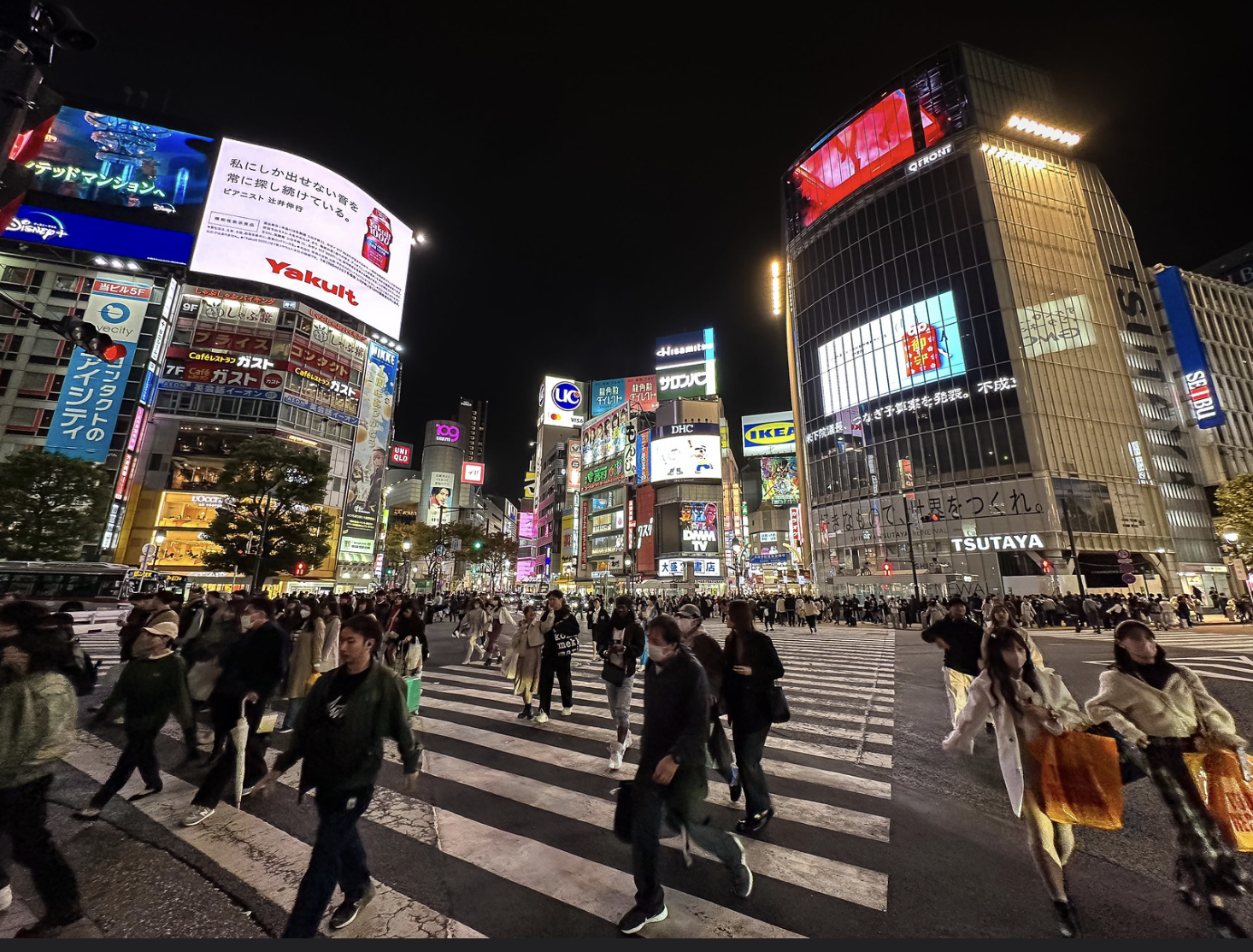
Photo credit: William Warby
