

By Kristen Belt, RCPC Board
In recent years, there has been a great deal of interest in supporting affordable housing in Rockridge. But what do we mean when we say “affordable housing”?
Naturally occurring affordable housing refers to rent-controlled apartments or homes that were purchased before housing prices escalated in the area. Rockridge has some of these types of units, though they are diminishing through natural turnover each year.
“Affordable by Design” refers to smaller, more efficient homes that may not have the space or amenities needed to command a market-rate rent or sale price. Accessory Dwelling Units (ADUs) can sometimes fall into this category. While the number of ADUs in Rockridge has certainly increased over the years, they are difficult to deliver at scale and are insufficient to meet the overall need.
Inclusionary housing refers to units that are built within a market-rate development and offered for rent or sale below market value. Currently, the City of Oakland has no citywide inclusionary housing requirement. Instead, it uses impact fees to support a fund that the City uses to develop 100% affordable housing projects. Still, some market-rate developers choose to include affordable units, typically to build community support or to take advantage of the State Density Bonus law, which provides flexibility in development standards for projects that include a certain percentage of affordable homes.
100% affordable housing projects are typically developed using a combination of local, State, and federal funds. They may also use special financing mechanisms such as the Low-Income Housing Tax Credit (LIHTC) to secure long-term financing at favorable interest rates. These projects serve a range of income levels, typically those earning up to 60% of the area median income (AMI), and have very specific eligibility requirements. Rents are generally capped at 30% of household income, made possible by public subsidies.
For these projects, total development cost and cost per unit are significant factors in determining whether a project can secure increasingly scarce public funding. As a result, affordable housing developers often rely on publicly owned land provided at no cost or at a reduced cost. They rarely have the resources to compete with market-rate developers for privately owned sites.
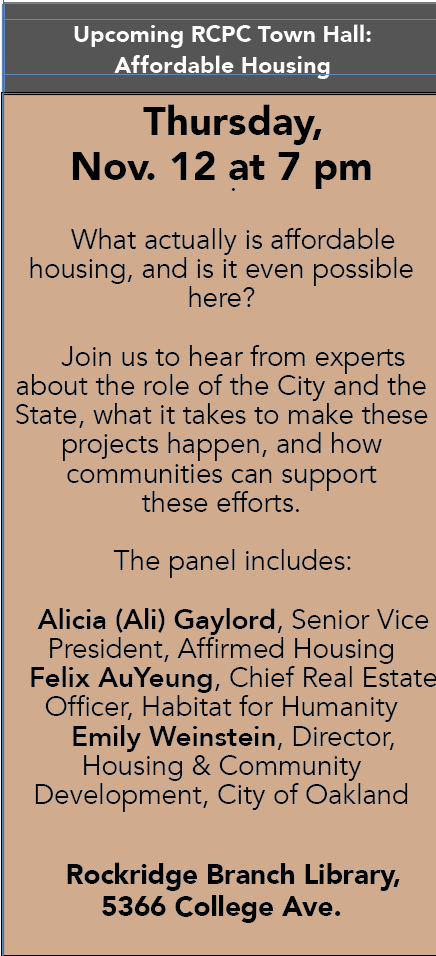
Understanding these different forms of affordability is important when we talk about how we can create and preserve more housing opportunities in Rockridge. Each approach plays a different role, and each has different opportunities and limitations. Want to learn more about affordable housing? Attend our forum on Nov. 12.
