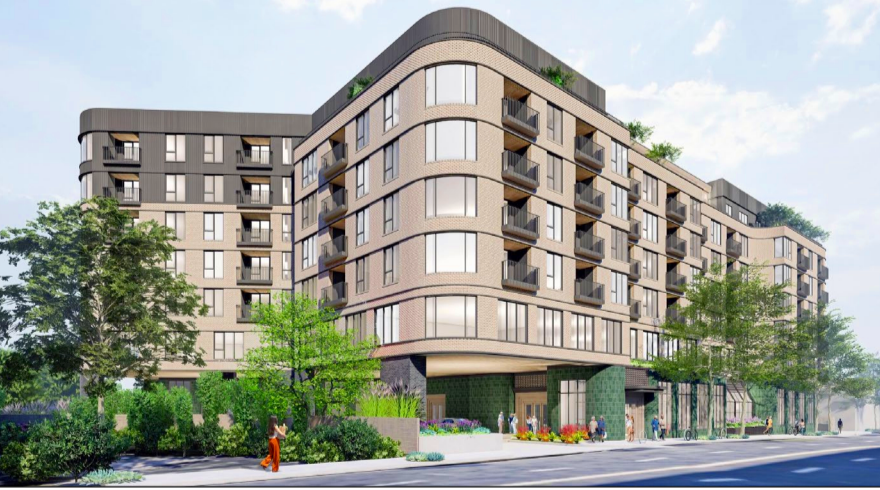
Height, Footprint, More
by Mark Aaronson, RCPC Board Member
On Jan. 21, seven Rockridge Community Planning Council (RCPC) designees met with three representatives from Ellis Partners and Spirit Living Group, the developers of a proposed Residential Care Facility for the Elderly (RCFE) at 6230 Claremont Ave. Issues raised included the height and bulk of the building; vehicle access on Claremont Ave. for all purposes; the method used to calculate residential density bonuses under recently enacted State law; and open-space proposals.
PROJECT DESCRIPTION AND APPROVAL PROCESS OVERVIEW
The proposed RCFE is a 203-unit, life-care, market-rate rental facility for seniors. Monthly charges are projected to be similar to those at Merrill Gardens.
The approval process will be the normal Oakland Planning Department’s Regular Discretionary Design Review. There will be public hearings before the Oakland Planning Commission makes final environmental impact and land use decisions regarding the proposed project, which may be as soon as this summer.
The design now under review describes the building height as a little under 85 feet with a rooftop terrace and protruding sections for utility equipment and an elevator shaft. It also indicates setbacks from the front and rear property boundary lines ranging from 5 to 10 feet. A circular porte-cochere drop-off,- main entry way and separate access to an underground 90-car garage are on Claremont Avenue. The ground floor ceiling height is 21½ feet and includes space for a partial mezzanine floor. Above that, there are six mainly residential floors.
The apartment mix consists of 24 Memory Care (MC) units, 20 Assisted Living (AL) units, and 159 Independent Living (IL) units including studio, one-bedroom and two-bedroom configurations. While the IL and AL units have full kitchen areas, facility-prepared meals will be available for residents in separate IL, AL and MC dining rooms.
The number of units and other land use factors, such as height and bulk, will be reviewed in accordance with State law density bonus provisions, which allow for buildings that exceed normal local zoning standards. RCFEs without any requirement for affordable housing qualify for such review.
SPECIFICALLY APPLICABLE OAKLAND AND STATE LAW
The project site is within Oakland’s CN-1 Neighborhood Commercial Zone. Permitted uses include multi-family housing. The combination of IL and AL as regular dwelling units with kitchens and MC as rooming units qualifies for consideration as a mixeduse building consistent with CN-1 zoning. The maximum building height for structures in a CN-1 zone is 55 feet, but that is subject to overriding State law. Determining when and how State law preempts Oakland land use law is a three-step process.
First, it involves calculating the base maximum allowable residential unit density of a proposed site under Oakland law and then the number of additional units authorized under State law as a 20% bonus. The base residential density cap for the 1.06-acre proposed RCFE site is 195 units, which—on an apportioned basis considering the two different types of residential units covered—includes 172 regular dwelling (IL and AL combined) units and 23 rooming (MC) units. The 20% bonus under State law yields a maximum allowable project site density of 232 residential units, which could include up to 205 regular dwelling units and 27 rooming units. The developers’ proposal of 159 IL units, 20 AL units, and 24 MC units falls within these limits.
Second, if the project design is within the maximum residential units permitted after the State bonus, it is up to the developer to request bonus density waivers for structural and design features not in compliance with local requirements. In this case, the main waivers requested by the developers involve the following Oakland zoning requirements: the 55-foot building height limit; 30-degree sloping stepbacks when residential properties abut; a consistent 10-foot rear setback from Florio St.; and positioning driveways, garage doors, and other vehicle access from a secondary frontage rather than a primary street like Claremont Ave. Initially, the developers requested a waiver from on-site open space requirements but have now determined that private balcony space can be included in square-footage calculations negating the need to request a waiver.
Lastly, the Planning Commission decides whether to grant waivers with important limitations on its discretion. In most cases, for a waiver to be denied, it has to “have a specific, adverse impact … upon health or safety, and for which there is no feasible method to satisfactorily mitigate or avoid the specific, adverse impact.” Cal. Government Code sec. 65915(e)(1). Furthermore, “a ‘specific, adverse impact’ means a significant, quantifiable, direct, and unavoidable impact, based on objective, identified written public health or safety standards, policies, or conditions....” Cal. Government Code sec. 65589.5(d)(2). Inconsistencies with local zoning ordinance or general plan land use designations are explicitly excluded as grounds for finding a specific, adverse impact.
NEIGHBORHOOD RESPONSES
Neighborhood views regarding the proposed project vary considerably. Some support the project because it adds housing. Several express specific interest as elderly individuals in selling their nearby houses and moving into the facility as a safe and supportive way to continue to reside in Rockridge.
The main opposition to the proposed project has come from Rockridge Neighbors for Sensible Housing (RNSH), which is largely composed of residents who reside on Auburn Ave. and Florio St. and who are most directly impacted by the RCFE’s height, bulk and traffic circulation. RNSH’s first response was to suggest alternative development for affordable housing. It now supports senior housing on the site but seeks improvements that refine building height and design to ensure maximum light, enhance health and safety, and promote livability, privacy and a comfortable streetscape.
The RCPC board has not yet taken a position on the project. Instead, it appointed a seven-member Consultation Committee, which includes four RNSH participants, to meet with the developers to obtain information and discuss changes in project design and impact.
At the Jan. 21 meeting, Committee members proposed lowering the ground floor height to 15 feet, building out the mezzanine as a full floor, and reducing the remainder of the building by one floor. Other issues addressed involved incorporating more significant step-backs, reducing the number of units by decreasing the likely hard-tomarket IL studios, providing support for all-purpose vehicular access on Claremont Ave, and contributing as a community benefit to furthering public open space in Rockridge.
Please send questions and comments about the proposed project to landuse@rockridge.org.